01
Normalize
Structure titles, parties, shares, territories, affiliations, and identifiers.
Technical & Legal FAQ
Detailed answers for publishers and rights executives evaluating royalty identification, bulk registrations, catalog security, and responsible AI licensing.
Find My RoyaltiesOperational guidance, not legal advice. Scope, controls, and destination coverage are confirmed during diligence and onboarding.
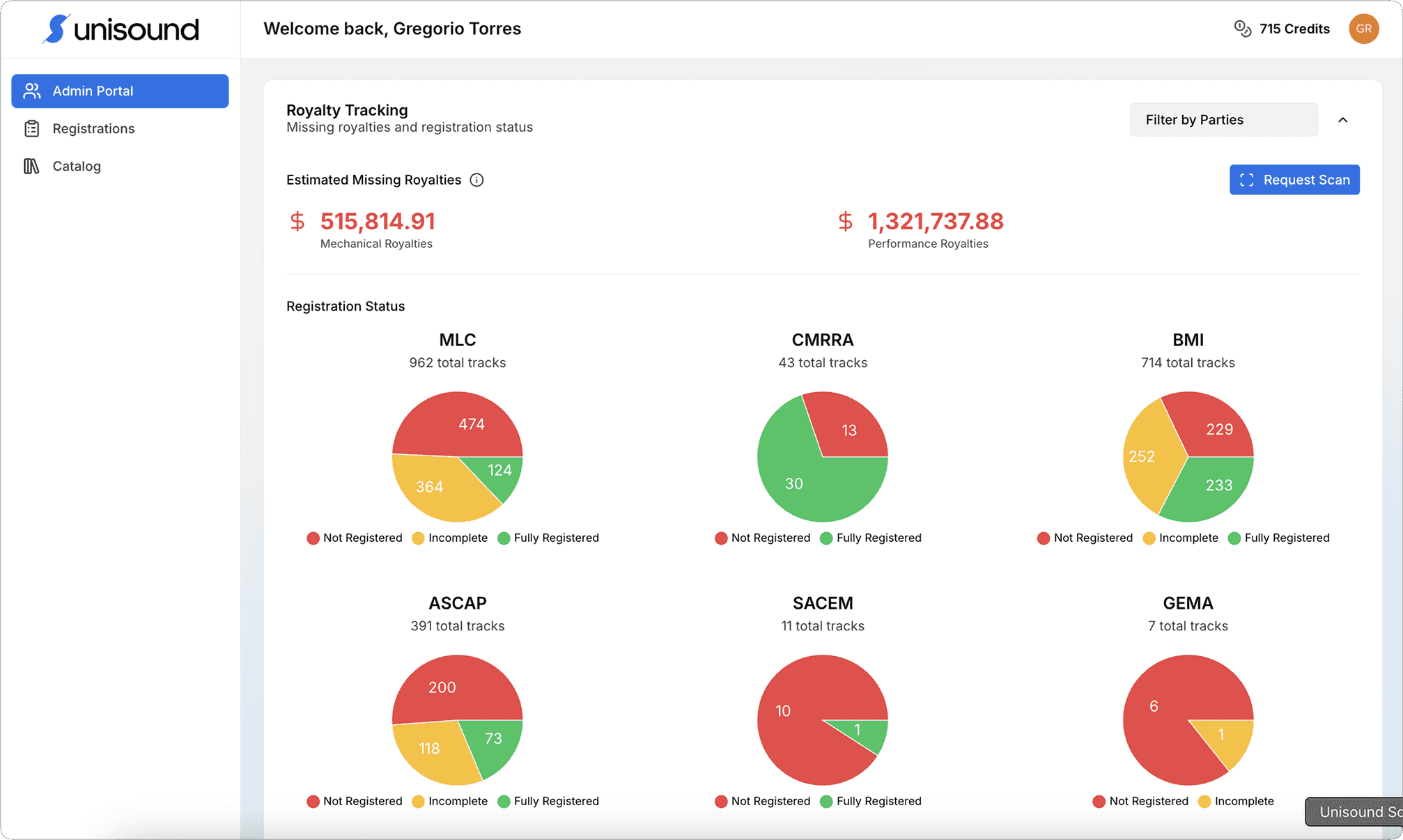
Unisound uses AI-assisted reconciliation to help identify registration and royalty gaps, prepare catalog data for downstream destinations, and route exceptions for human review. A discrepancy is an investigative lead, not a payment guarantee.
Structure titles, parties, shares, territories, affiliations, and identifiers.
Compare records and rank likely matches, conflicts, omissions, and duplicates.
Route ownership-sensitive or ambiguous exceptions for documented human review.
Map approved data to destination rules and track acknowledgments or rejections.
How catalog records become actionable leads, and where human judgment remains essential.
The process starts by normalizing the client’s catalog data: titles, writers, publishers, controlled shares, territories, society affiliations, and identifiers such as ISWC, IPI, and ISRC. The system can then compare those records with available repertoire and society data to surface missing registrations, conflicting shares, unmatched parties, duplicate records, and identifier gaps.
AI is used to rank and reconcile likely matches across inconsistent names, titles, and metadata. Exceptions that could affect ownership or payment should be reviewed before a correction, claim, or registration is submitted. This is data reconciliation, not an autonomous legal determination.
An ISWC identifies a musical work. An IPI identifies an interested party such as a writer or publisher. An ISRC identifies a specific sound recording, not the underlying composition. Reliable administration connects these identifiers without treating them as interchangeable. CISAC’s Common Information System uses standardized identifiers and formats to support rights-data exchange and more accurate distributions. See the CISAC identifier guidance.
No. A discrepancy shows that records may be incomplete, inconsistent, duplicated, or unmatched. Recoverability depends on the client’s rights and mandate, actual reported usage, territory, applicable limitation or claim periods, competing claims, documentation, and the processing rules of the relevant society or organization.
High-confidence administrative matches can be prepared for action, while ambiguous records should be placed in an exception queue. The review record should preserve the source data, proposed match, confidence or reason code, ownership documentation, reviewer decision, and submission outcome. Material conflicts should not be resolved solely by probabilistic matching.
A destination-aware workflow for works, recordings, metadata systems, and exception tracking.
A typical workflow has seven stages: catalog intake; normalization; authority and ownership validation; destination-specific field mapping; batch preflight; submission through the method accepted by the destination; and acknowledgment, rejection, and exception tracking. The objective is not merely to send a file. It is to create a traceable record from source metadata through destination response.
Required fields and formats vary. A musical-work registration may require writer, publisher, split, affiliation, and territory data, while a sound-recording repertoire submission relies on recording-level data such as ISRC, artist, title, release information, and rights dates.
SoundExchange is not a musical-work PRO. It is the U.S. organization designated to administer statutory digital performance royalties for sound recordings under Section 114. Its public guidance says registered rights owners can deliver recording repertoire through SXDirect, DDEX feeds, and flat Excel files, including bulk submissions. See SoundExchange’s ISRC and repertoire guidance.
For SoundExchange-oriented work, Unisound’s role is best understood as preparing and validating recording-level metadata, mapping controlled rights, organizing the submission, and tracking exceptions. Acceptance and payment remain subject to SoundExchange’s rules and records.
DISCO is not a PRO or CMO, so “registration” is not the same process. DISCO is a cloud platform for managing, searching, sharing, and delivering music and metadata. It supports bulk uploads, CSV metadata workflows, catalog access controls, and, on Enterprise plans, API workflows.
Where DISCO is part of a client’s operating stack, a delivery workflow may organize audio, identifiers, writer and publisher data, ownership notes, clearance contacts, and custom fields so the catalog is searchable and licensing-ready. DISCO states that its Catalogs can collect licensing requests but do not themselves issue the license. See the DISCO Catalogs guide.
Usually not without transformation. Societies and platforms use different schemas, identifiers, mandatory fields, controlled vocabularies, ownership rules, and transmission methods. A responsible bulk workflow maintains a canonical catalog record, then maps that record to each destination instead of forcing one spreadsheet into every system.
The technical and contractual questions an enterprise buyer should validate before onboarding.
Confirm the current implementation and contractual commitment for each control area. This page does not substitute for a security review.
Catalog security should be evaluated as both a technical and contractual control set. During diligence, publishers should confirm the current controls covering user access, encryption in transit and at rest, tenant separation, activity logging, backup and recovery, retention and deletion, incident response, subprocessors, and data residency.
Unisound’s public materials reviewed for this FAQ do not publish a specific certification or detailed security architecture. Accordingly, this page does not claim SOC 2, ISO 27001, or any other certification. Applicable commitments should be documented in the current agreement, data-processing terms, and security materials provided for the engagement.
Access should follow least-privilege principles and reflect operational roles. Catalog ingestion, metadata review, submission approval, commercial licensing, and administrative access should be separable where the engagement requires it. Executive buyers should also confirm how access is revoked, how service accounts are governed, and whether actions affecting ownership or licensing are logged and reviewable.
It should not be assumed that administrative access equals permission to train a model. Publishing administration, internal matching, and third-party model training are legally and commercially distinct purposes. Any use beyond the contracted administration scope should require a clear contractual basis and an identified rights mandate.
A rights-scoped, affirmative process for evaluating and documenting a training transaction.
Compositions, recordings, controlled shares, territories, exclusions, and chain of authority.
Training, fine-tuning, evaluation, retrieval, output generation, model versions, and sublicensing.
Fees, guarantees, revenue shares, reporting, allocation rules, attribution, and audit rights.
Security, retention, deletion, output restrictions, warranties, conflicts, and termination effects.
Where Unisound supports or administers an AI-training transaction, the process should begin with an affirmative mandate from the rights holder, not with passive ingestion. The parties identify the compositions and/or sound recordings included, verify controlled shares and territories, and define the permitted technical uses: for example, training, fine-tuning, evaluation, retrieval, or output generation.
The license then addresses term, exclusivity, sublicensing, model and version scope, data retention or deletion, compensation, reporting, audit rights, output restrictions, attribution where applicable, warranties, indemnities, and what happens after termination. Delivery should occur only after the approved repertoire and rights scope are documented.
No such grant should be inferred from upload alone. A training license is a separate rights transaction. The rights holder must have authority over the relevant composition, sound recording, or controlled share, and the written agreement should state exactly what the AI company may do.
Not automatically. A track may involve separate rights in the musical work and the sound recording, controlled by different parties and in different percentages or territories. A dataset may require one or both layers depending on the technical use. The clearance matrix should identify each layer and exclude rights the licensor does not control.
The legal position is jurisdiction- and fact-specific. The U.S. Copyright Office’s AI training report analyzes consent, compensation, fair use, and licensing without declaring that every training use always requires, or never requires, a license. Other jurisdictions may apply different text-and-data-mining rules and rights-reservation mechanisms. Parties should obtain advice from qualified counsel for the intended use, territory, and dataset.
A commercial workflow can be structured around affirmative opt-in, repertoire-level exclusions, or recorded reservations of rights. IFPI notes that copyright owners may make general or specific reservations, including for AI uses. SoundExchange has also announced a voluntary AI sound-recording registry intended to communicate authorization declarations. Whether a particular mechanism is legally effective depends on jurisdiction and implementation. See IFPI’s reservations guidance and the SoundExchange announcement.
The allocation method belongs in the agreement. Possible structures include fixed fees, usage-based payments, revenue shares, minimum guarantees, or combinations. Allocation also depends on which rights are licensed, controlled shares, territory, repertoire eligibility, and reporting data. Unisound should not be understood to guarantee a particular valuation or payment outcome unless it is expressly agreed.
Unisound provides technology-enabled publishing administration. It does not replace title review, chain-of-title analysis, conflict resolution, society adjudication, or advice from qualified legal counsel. A successful technical submission does not by itself establish ownership, resolve a competing claim, or guarantee payment.
Evaluate registration gaps, metadata readiness, destination workflows, and AI-licensing controls against your catalog and mandate.
Find My Royalties